
Talent may open the door. Practice is what makes a student walk through it.
There’s a moment that happens quietly in every serious arts school.
Two students join at the same time. One looks “gifted” in week one. The other looks average-maybe even clumsy. Parents notice it instantly, and in their minds they quietly rank the children.
But performance skill doesn’t grow like first impressions. It grows like compounding interest.
What looks like “talent” is often only a head start: quick mimicry, good confidence, fast memory. But what builds mastery-real, stable mastery-is something less glamorous and more powerful:
A repeatable practice system.
This is not motivational talk. This idea is strongly supported in performance science through what is called deliberate practice-practice designed specifically to improve weaknesses through repetition, feedback, and structured difficulty. This concept is widely associated with research by K. Anders Ericsson and colleagues.
Why this matters for parents
Your child does not need to be “special” to become excellent. Your child needs a system.
The real reason students don’t improve isn’t lack of ability. It’s random practice.
Random practice looks like:
- repeating the full dance piece again and again with the same posture mistake
- singing the same song repeatedly without fixing the sruti drift
- playing the same guitar part fast, but always sloppy
- drawing only what feels easy and avoiding difficult observation
It feels like effort. But it doesn’t create transformation.
Kairali’s method is the opposite: we don’t chase “more hours”. We chase cleaner learning.
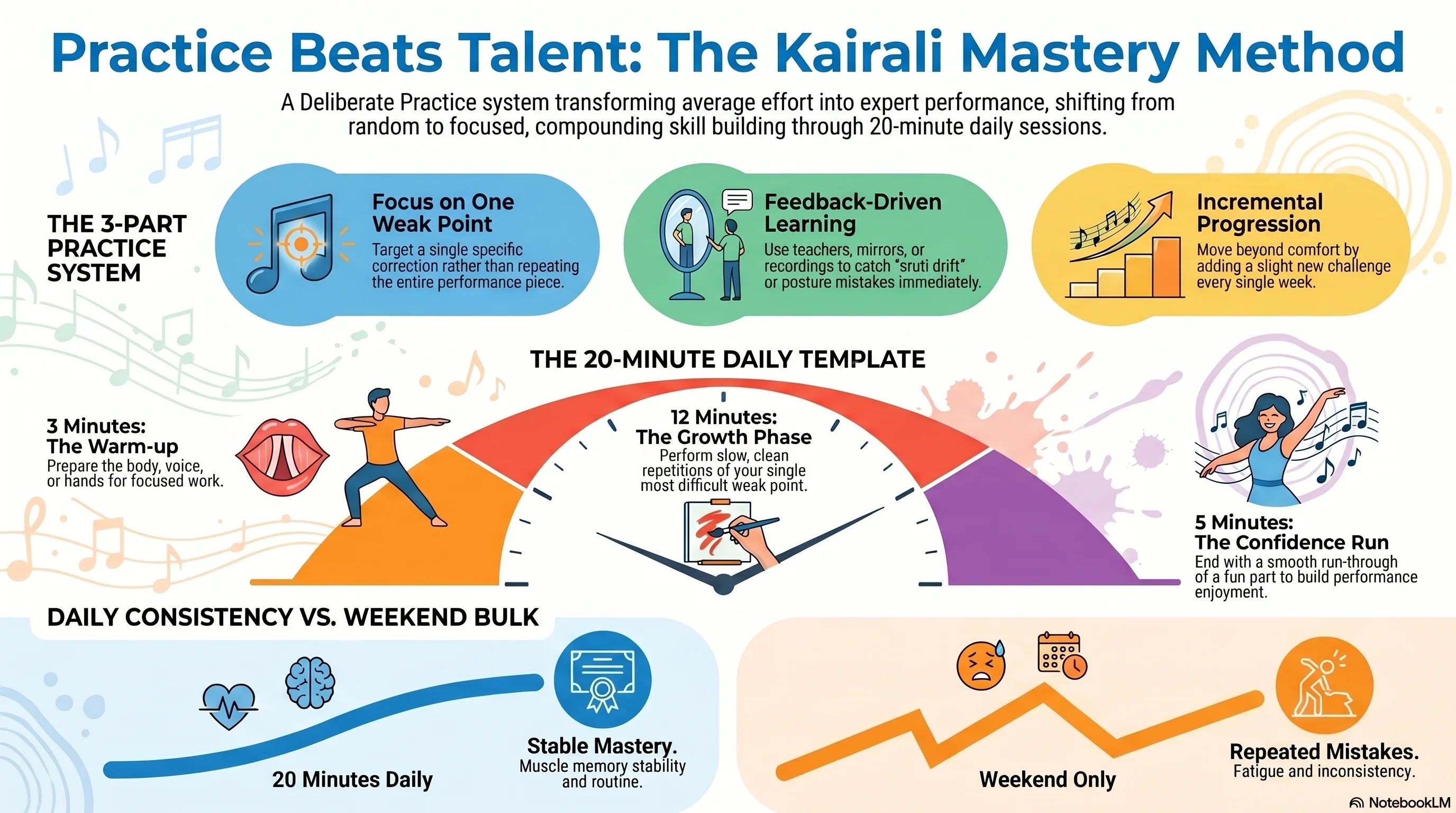
The 4-part Practice System (Simple, Powerful, Real)
- One goal (not ten goals)
- One weak point (not the whole performance)
- Feedback (teacher correction, recording, mirror, metronome/tala)
- Progression (slightly more challenge each week)
Why 20 Minutes Daily Works Better Than Weekend Practice
Parents often underestimate 20 minutes because they measure practice only in time. But learning is not time-based; learning is attention + repetition + correction.
A student doing 20 minutes daily builds:
- routine
- focus
- muscle memory stability
- faster correction retention
A student doing long practice only on weekends builds:
- fatigue
- inconsistency
- repeated mistakes
That’s why we keep saying: 20 minutes daily is enough to improve-when it is structured.
Kairali 20-Minute Practice Template
- 3 minutes: warm-up (body/voice/hands)
- 12 minutes: one weak point (slow, clean reps)
- 5 minutes: smooth run-through (enjoyment + confidence)
The single best rule: practice the corrections first, not the fun parts first. Because the fun parts keep you in comfort. Corrections move you into growth.
Parent Tip (Most Effective Support You Can Give)
Instead of asking “Did you practice?” Ask this:
“What was the one correction you practiced today?”
That question trains the child to think like a learner, not a performer.
Rate this insight
Was this useful?
Share this article