When output becomes cheap, meaning becomes expensive.
AI is not coming.
AI is already here.
It will change jobs, workflows, and the value of routine work.
So the question is not:
“Will AI affect careers?”
The question is:
“What stays valuable when machines can generate output faster than humans?”
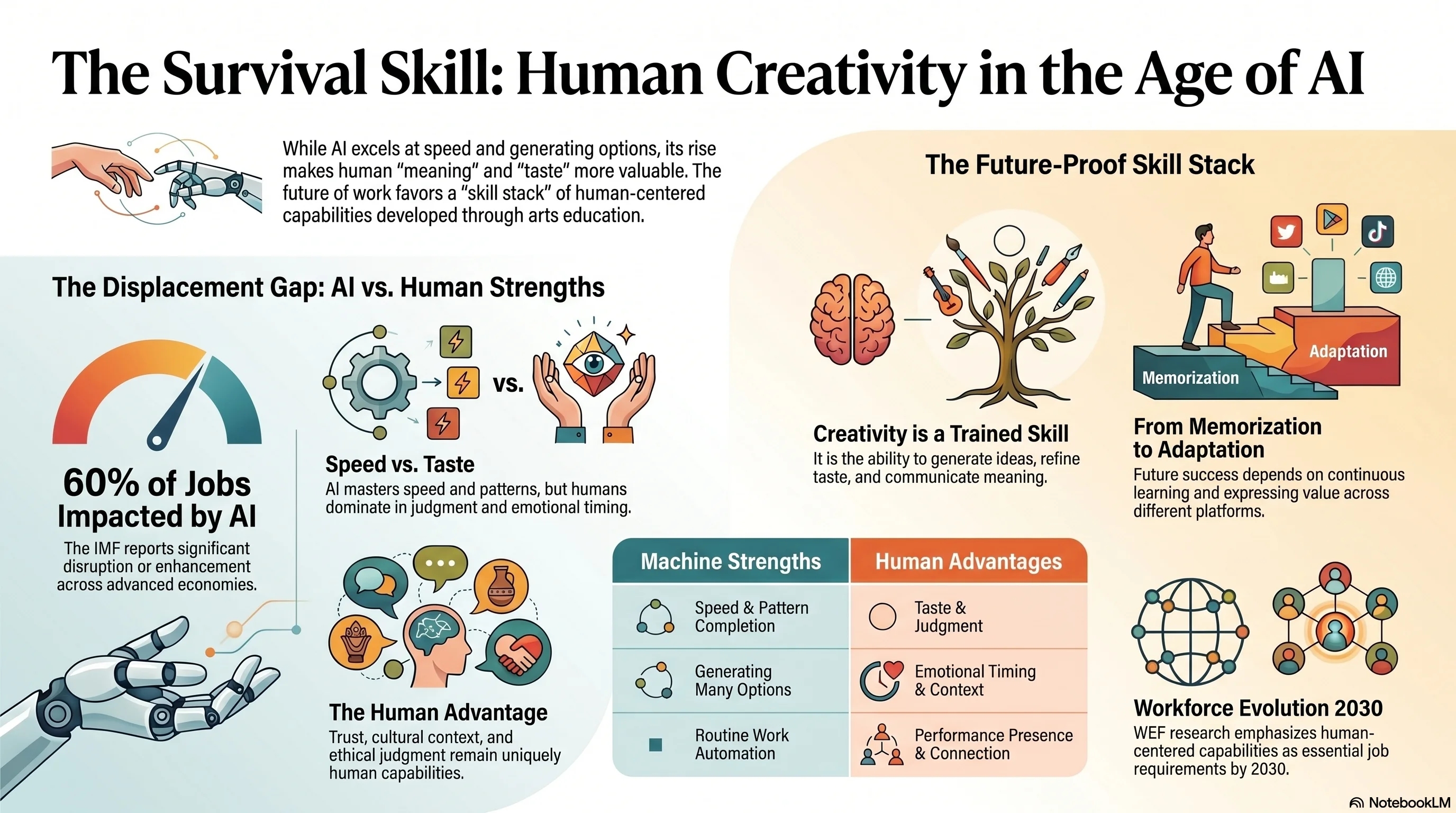
The IMF has discussed that in advanced economies, around 60% of jobs may be impacted by AI, with some roles enhanced and others disrupted depending on exposure and complementarity.
So what survives? Not a job title. A skill stack.
The Human Advantages That Do Not Automate Easily
AI is powerful at:
- speed
- pattern completion
- generating many options quickly
But humans still dominate in:
- taste (what’s worth making)
- judgment (what’s correct, ethical, appropriate)
- emotional timing (how it feels)
- cultural context (what it means here)
- performance presence (trust and connection)
These are exactly what arts education trains.
WEF workforce research repeatedly highlights that significant skill change is expected by 2030, emphasizing continuous learning and human-centered capabilities as job requirements evolve.
Why Creativity is Not “Talent”
Creativity is:
- ability to generate ideas
- ability to refine taste
- ability to execute consistently
- ability to communicate meaning
In other words: creativity is trained.
What Parents Should Understand Now
The safest child is not the one who memorizes quickly. The safest child is the one who can:
- learn continuously
- express clearly
- create something valuable
- perform under pressure
- adapt across platforms
That is why structured arts training matters now more than ever.