
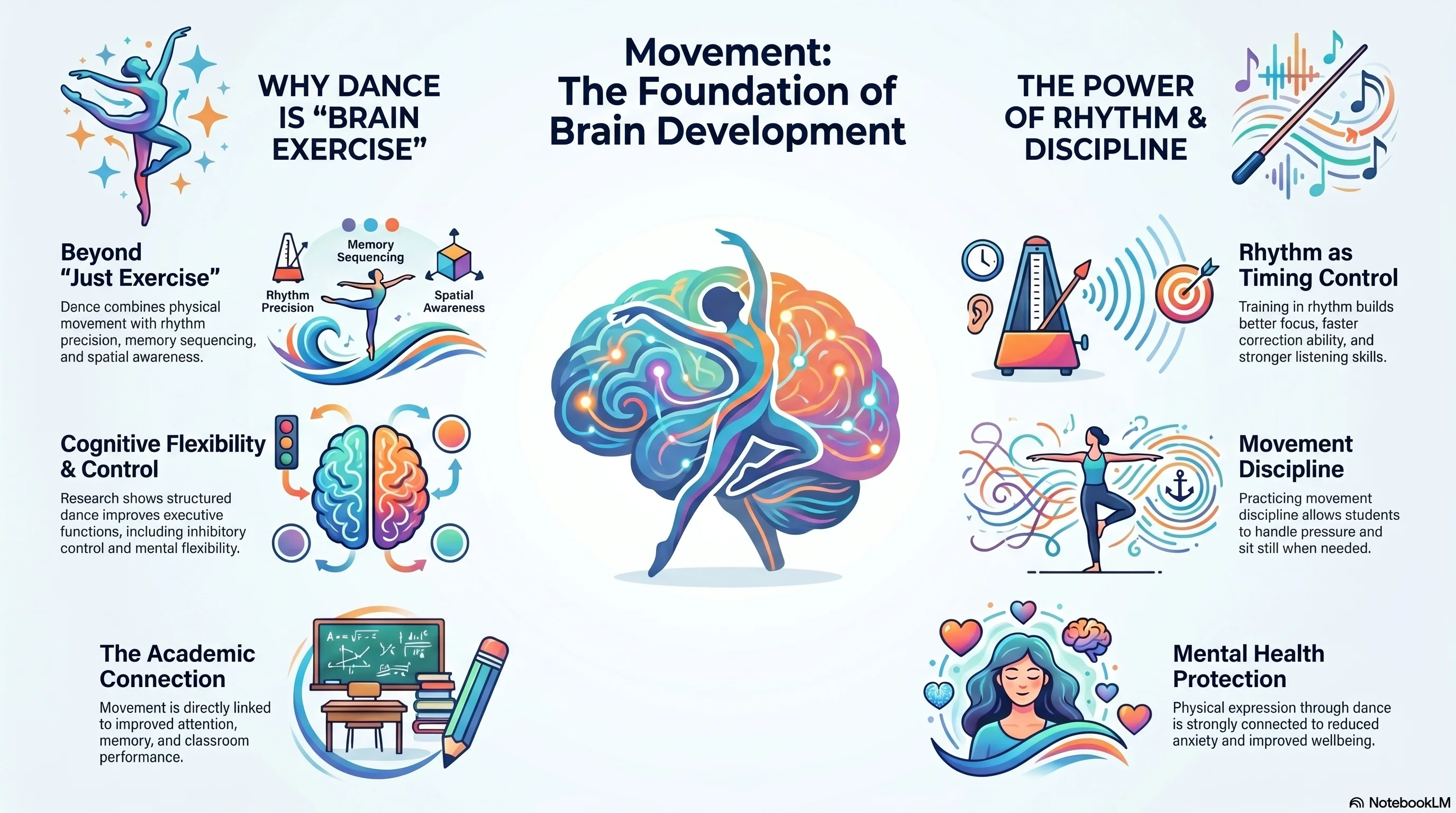
Movement isn’t extra. It’s brain development in motion.
🎧 Listen to this article
Many families treat movement like a hobby: “If studies are strong, arts can be optional.”
But movement is not optional for healthy development. It is a foundation system that influences:
- attention
- mood
- coordination
- memory
- confidence
- classroom performance
Major public health sources consistently link physical activity to benefits for children and adolescents including cognitive development, academic achievement, and wellbeing.
Why Dance is Special Compared to “Just Exercise”
Dance is movement plus:
- rhythm precision
- memory sequencing
- spatial awareness
- expression
- group synchronization
That means dance is cognitively demanding in a positive way.
Recent research has also explored how structured dance interventions can improve executive functions in young children, including cognitive flexibility and inhibitory control.
What Rhythm Training Builds in Students
Rhythm is timing control. Timing control builds:
- better focus
- better listening
- faster correction ability
- stronger confidence on stage and in daily life
Why Kairali Emphasizes Movement Discipline
Because movement discipline creates a student who can:
- sit still when needed
- focus longer
- handle pressure
- manage emotions through expression
These are not “arts-only” benefits. They are life benefits.
Parent Perspective: Movement Protects Mental Health Too
Physical activity is also strongly connected to reduced anxiety and improved wellbeing in many public health summaries, including children’s brain health and academic performance benefits.
Rate this insight
Was this useful?
Share this article