
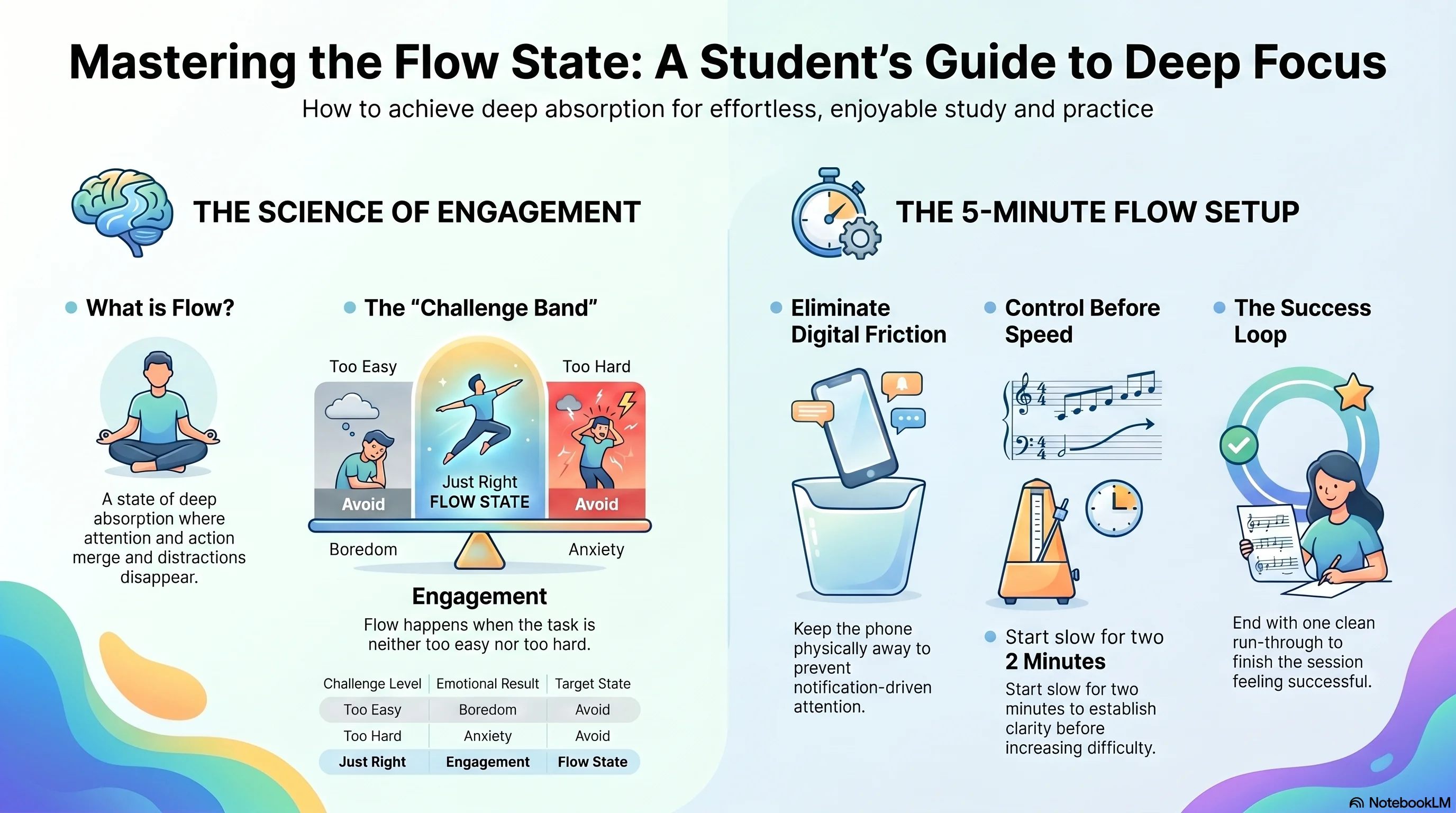
Flow isn’t luck. It’s a trained environment.
Every teacher recognizes it. Every student feels it at least once.
A day where the mind stops distracting itself. A day where the body listens. A day where practice becomes strangely enjoyable.
Students describe it like this:
- “I didn’t even feel tired.”
- “I didn’t overthink.”
- “It just happened.”
Psychology calls this state FLOW-deep absorption where attention and action merge.
Flow is commonly described using repeatable conditions such as:
- clear goals
- immediate feedback
- a balance between challenge and skill
This framework is widely associated with Mihaly Csikszentmihalyi’s work and is repeated across many educational and performance summaries.
Why Students Today Struggle With Flow
Not because they’re weak. Because modern life trains the opposite of flow:
- notification-driven attention
- short dopamine loops
- switching tasks constantly
Flow requires uninterrupted attention. That is why arts training is secretly attention training.
What Kairali is Really Training (Beyond Art)
We train:
- focus stamina
- learning patience
- correction acceptance
- performance under pressure
Because in the future, focus will be a rare advantage.
How Kairali Builds Flow Without Saying “Flow”
Flow collapses if training is either too easy or too hard.
- Too easy = boredom
- Too hard = anxiety
- Just right = engagement
That’s why Kairali teaches in levels. Not to slow students down. To keep students in the correct “challenge band” so learning remains enjoyable and sustainable.
The 5-Minute Flow Setup (Before Practice)
- Keep the phone away (not just silent-away)
- Set one sentence goal: “Today I will improve ______.”
- Start slow for 2 minutes (control before speed)
- Increase difficulty only after clarity appears
- End with one clean run-through (finish feeling successful)
Why This Works
Flow is built by clarity + feedback. If a student knows what success looks like, and can immediately detect errors, focus becomes natural.
Parent Tip
The best support is not pressure. It’s environment:
- quiet space
- same practice time daily
- small consistent routine
Rate this insight
Was this useful?
Share this article